CLV & Customer Intelligence
Not All Customer
Growth is Good Growth
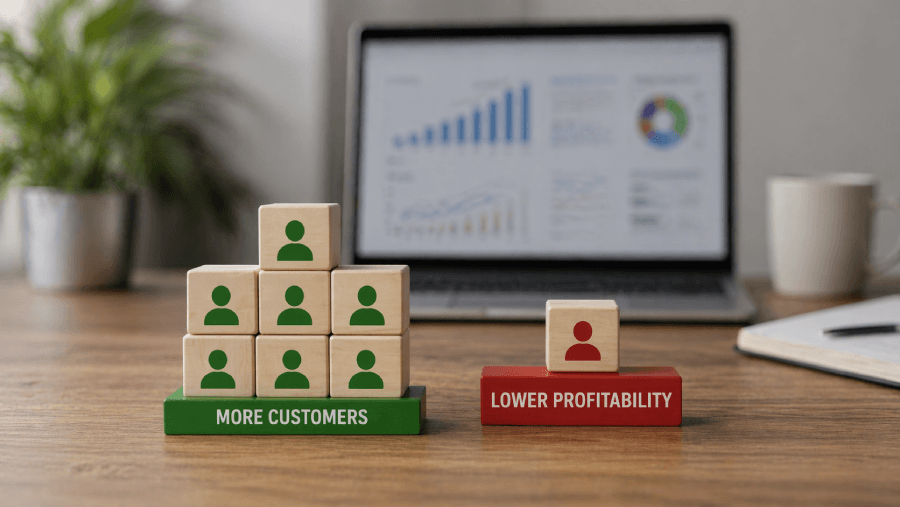
More customers are not automatically better growth. That sounds obvious. Retail teams still miss it all the time.
When low-quality acquisition starts to dominate, the warning signs show up fast:
I have seen this pattern play out in quarterly reviews more times than I care to admit. The acquisition line is up. The loyalty metrics are flat or slightly down. Nobody wants to connect the two because the acquisition win feels real and immediate, while the loyalty softness feels like a separate problem that can be solved later.
It is not a separate problem. It is the same problem showing up in two places.
*Forrester predicted rising prices would drive a 25% decline in brand loyalty in 2025 even as loyalty programs gain popularity.* To me, that sharpens the point. Retailers cannot assume new demand automatically turns into future value. That progression has to be earned, and the window to earn it is usually narrower than teams expect.
A new customer is not automatically an asset. Sometimes it is just an expensive first transaction.
That is where CLV changes the discussion.
Instead of asking:
The teams that learn to live with that discomfort end up with a healthier customer base eighteen months later. The teams that do not spend those eighteen months trying to figure out why the file looks larger but the economics feel thinner.
In my experience, that gap is almost always a CLV-quality gap that was invisible at acquisition and only became visible much later by which point the most effective interventions were already behind the business.
I go deeper on this in the full article, especially why weak acquisition can look healthy before it quietly weakens the business.
- The customer count gets larger.
- Orders go up.
- Top-line demand looks healthy.
When low-quality acquisition starts to dominate, the warning signs show up fast:
- Customer retention rates start to drop.
- Average order frequency declines.
- Customer acquisition costs rise.
I have seen this pattern play out in quarterly reviews more times than I care to admit. The acquisition line is up. The loyalty metrics are flat or slightly down. Nobody wants to connect the two because the acquisition win feels real and immediate, while the loyalty softness feels like a separate problem that can be solved later.
It is not a separate problem. It is the same problem showing up in two places.
*Forrester predicted rising prices would drive a 25% decline in brand loyalty in 2025 even as loyalty programs gain popularity.* To me, that sharpens the point. Retailers cannot assume new demand automatically turns into future value. That progression has to be earned, and the window to earn it is usually narrower than teams expect.
A new customer is not automatically an asset. Sometimes it is just an expensive first transaction.
That is where CLV changes the discussion.
Instead of asking:
- How many customers did we acquire?
- How fast did we acquire them?
- What did each one cost?
- How many potentially valuable customers did we begin to build?
- What signals suggest they can progress?
- Are we attracting the kind of customer the business can actually grow?
The teams that learn to live with that discomfort end up with a healthier customer base eighteen months later. The teams that do not spend those eighteen months trying to figure out why the file looks larger but the economics feel thinner.
In my experience, that gap is almost always a CLV-quality gap that was invisible at acquisition and only became visible much later by which point the most effective interventions were already behind the business.
I go deeper on this in the full article, especially why weak acquisition can look healthy before it quietly weakens the business.